Condyloma acuminatum is associated with:

  # Condyloma acuminatum is associated with:
A. HPV
B. HHV 8
C. CMV
D. EBV


The correct answer is A. HPV.

Approximately 90% of condylomata acuminata are related to HPV types 6 and 11. These 2 types are the least likely to have a neoplastic potential. It is characterised by transmissible, autoinoculable soft pink nodules which proliferate and coalesce rapidly to form diffuse papillomatous clusters or as papillomatous, bulbous masses of varying sizes. Topical podophyllin may be used or surgical excision may be needed to treat the lesion. 

The term poikilokaryosis refers to :

 # The term poikilokaryosis refers to :
A. Alteration of nuclear cytoplasmic ratio
B. large, prominent nucleii
C. division of nuclei without division of cytoplasm
D. loss of polarity and disorientation of cells


The correct answer is C. Division of nuclei without division of cytoplasm.

Criteria for diagnosis of epithelial dysplasia in carcinoma include: 
• Increased abnormal mitoses 
• Individual cell keratinisation 
• Epithelial pearls in the spinous layer 
• Alterations in nuclear Cytoplasmic ratio 
• Loss of polarity and disorientation of cells 
• Hyper chromatism 
• Large nucleoli 
• Dyskaryosis or nuclear atypism including giant nuclei. 
• Poikilokarynosis or division of nuclei without division of cytoplasm 
• Basilar hyperplasia Individual cell keratinisation and epithelial pearl formation is absent in carcinoma in situ or intra epithelial carcinoma. 


Which is a premalignant lesion?

 # Which is a premalignant lesion?
A. Oral submucous fibrosis
B. Syphilitic glossitis
C. Erythroplakia
D. Lichen planus


The correct answer is C. Erythroplakia.

Premalignant lesion according to WHO (1978) is defined as a morphologically altered tissue in which cancer is more likely to occur than its apparently normal counterpart. Examples include leukoplakia, erythroplakia, carcinoma in situ. 

Precancerous condition is a generalised state associated with a significantly increased risk of cancer. These include siderophenic dysphagia, submucous fibrosis, lichen planus, syphilitic glossitis. 

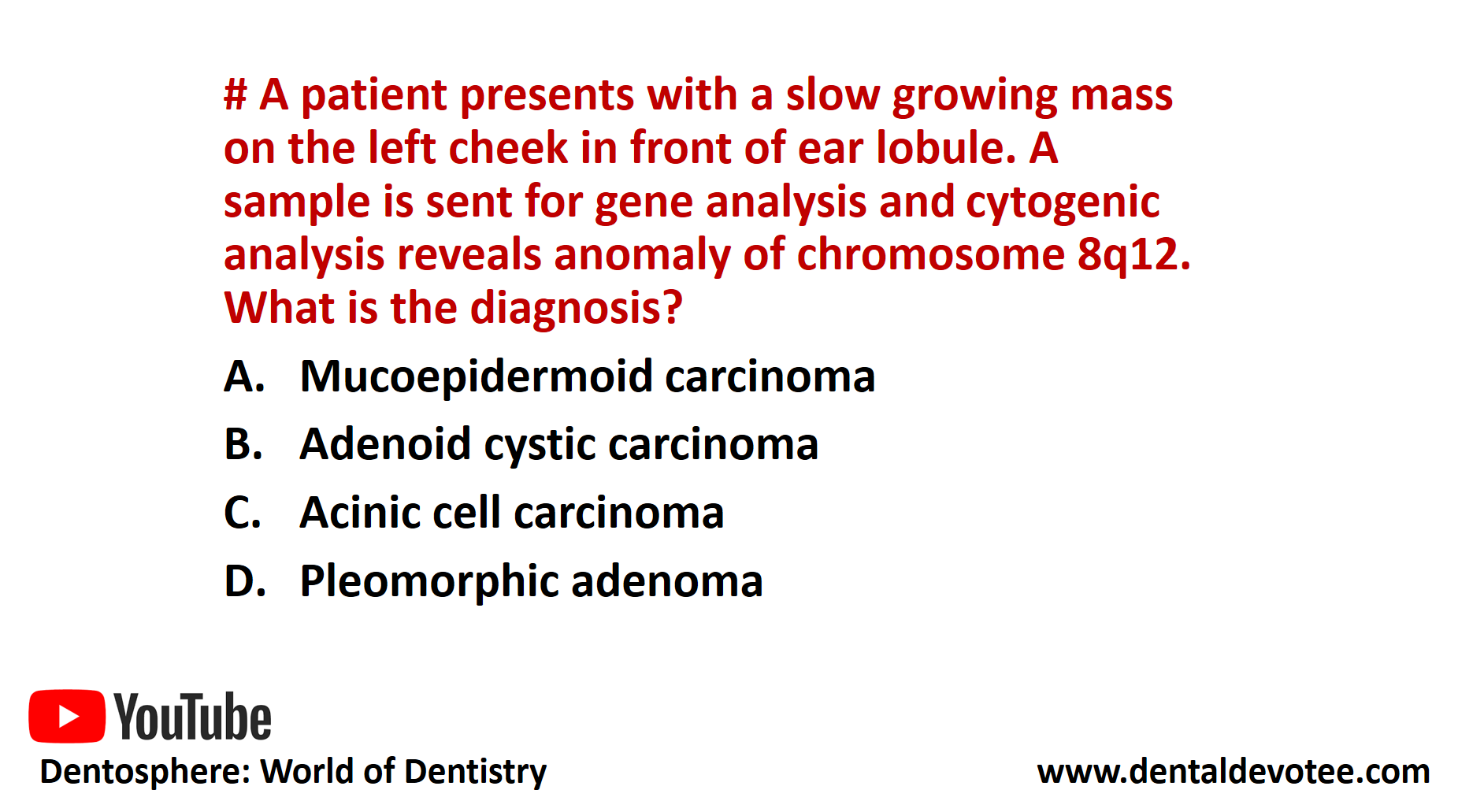
Anomaly of chromosome 8q12 with slow growing mass on the left cheek in front of ear lobule

 # A patient presents with a slow growing mass on the left cheek in front of ear lobule. A sample is sent for gene analysis and cytogenic analysis reveals anomaly of chromosome 8q12. What is the diagnosis?
A. Mucoepidermoid carcinoma
B. Adenoid cystic carcinoma
C. Acinic cell carcinoma
D. Pleomorphic adenoma


The correct answer is D. Pleomorphic adenoma.

The cytogenetic abnormality of chromosome 8q12 is clearly indicative of Pleomorphic adenoma. 

Pleiomorphic adenoma is most commonly seen in the Parotid gland. 
PLEOMORPHIC ADENOMA 
• Synonym: Mixed tumor. 
• Histogenesis: Following are the possible origins: - Myoepithelial cell - Intercalated duct reserve cell 
• It is the most common tumor of salivary gland cell. - Constitutes > 50% of all salivary gland tumors. - Constitutes 90% of all benign salivary gland tumors. 

• It contains cells of pleomorphic origin (can differentiate into epithelial- ductal/ non-ductal and mesenchymal cells-chondral, myxoid, osseous cells) 
• Genetics: PLAG1 (Pleomorphic Adenoma gene) mapped to chromosome 8q12 may be responsible for pleomorphic adenoma. 
• Clinical features: - Benign tumor; It is a mixed tumor i.e., composed of both ductal and myoepithelial cells (as against monomorphic adenomas that are composed of only one cell type). - Parotid is the most common site overall; intraorally, palate is the most common site.


Featured Post

Dental MCQs - Multiple Choice Questions in Dentistry

SELECT THE TOPIC YOU WANT TO PRACTICE. # LOK SEWA  AAYOG PAST QUESTIONS Medical Entrance Preparation MCQs # Digestive System and Nutriti...

Popular Posts