Which of the cells most commonly found in granuloma? Lok Sewa 2079

 # Which of the cells most commonly found in granuloma? 
(A) Lymphocytes 
(B) Giant cells 
(C) Mast cells 
(D) Neutrophils


The correct answer is B. Giant cells.

The cell most commonly found in granuloma is giant cells. A granuloma is a type of inflammation that occurs in response to chronic infection or inflammation. It is characterized by the accumulation of immune cells such as macrophages, lymphocytes, and giant cells, which are often surrounded by a rim of fibrous tissue. Giant cells are formed by the fusion of macrophages and are a characteristic feature of granulomas. They are often multinucleated and can be identified by their large size and distinctive appearance under the microscope. Lymphocytes are also commonly found in granulomas, but giant cells are the most characteristic cell type. Mast cells and neutrophils are less commonly found in granulomas.
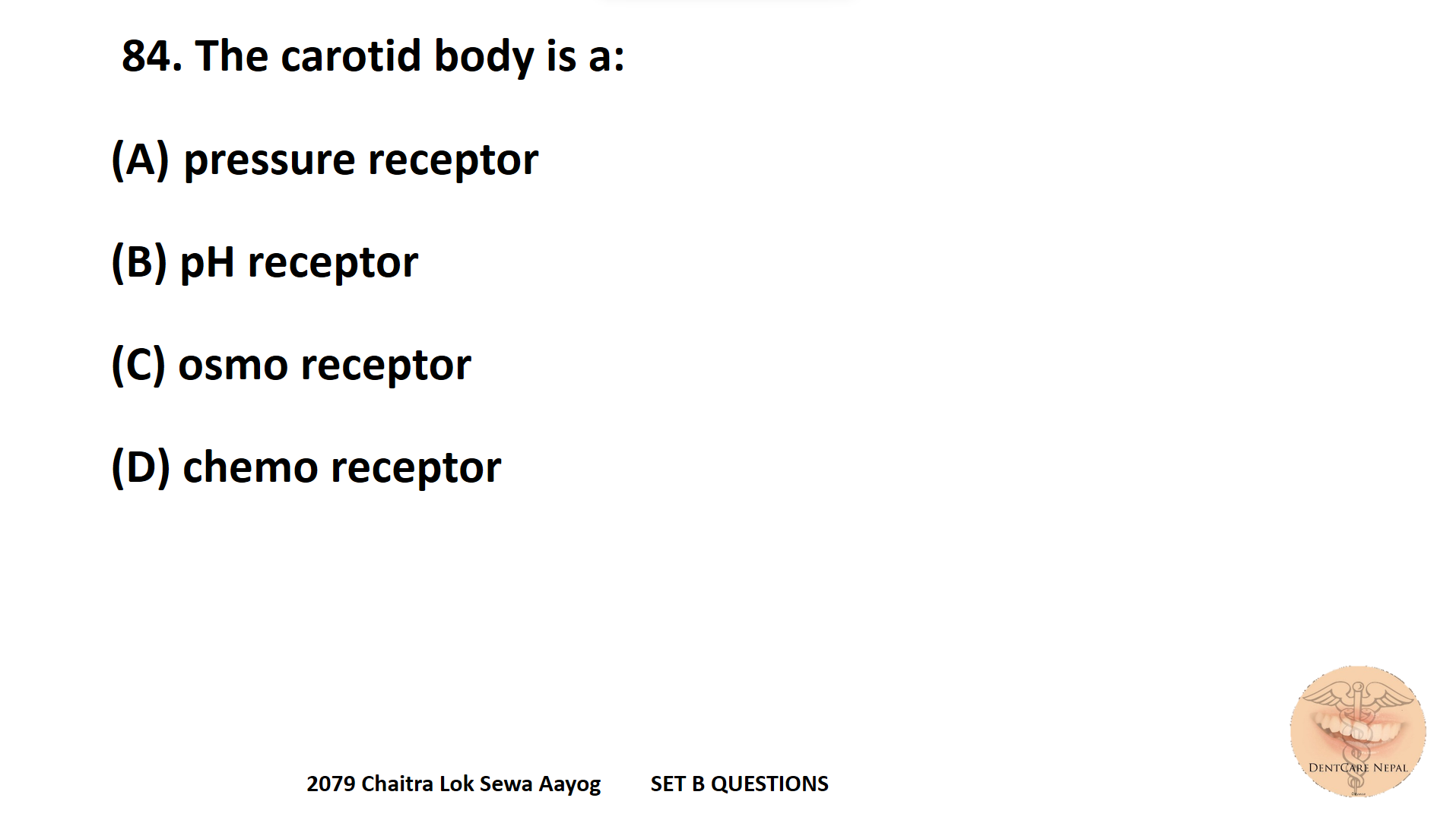
The carotid body is a: Lok Sewa Aayog 2079

  # The carotid body is a:
(A) pressure receptor 
(B) pH receptor 
(C) osmo receptor 
(D) chemo receptor


The correct answer is D. Chemo receptor. 

The carotid body is a chemoreceptor. It is a small cluster of specialized cells located near the bifurcation of the common carotid artery in the neck. The carotid body senses changes in the levels of oxygen, carbon dioxide, and pH in the blood and sends this information to the brainstem, where it is used to regulate breathing rate and other physiological responses. The carotid body is an important component of the body's homeostatic control mechanisms, helping to ensure that oxygen levels in the blood are maintained within a narrow range.

The suture that maintains strength for longest time is: Lok Sewa Aayog 2079

 # The suture that maintains strength for longest time is:
 (A) Dexon 
(B) Vicryl 
(C) PDS 
(D) Chromic catgut 


The correct answer is C. PDS. 

The suture that maintains strength for the longest time is PDS (Polydioxanone). PDS is a synthetic absorbable suture that is gradually broken down by hydrolysis and is intended to be absorbed by the body over a period of approximately 6 months. In comparison, Vicryl (Polyglactin 910) and Dexon (Polyglycolic acid) are also absorbable sutures, but they typically maintain their strength for a period of 4 to 6 weeks and 4 to 6 months, respectively. Chromic catgut is a natural absorbable suture that is made from purified collagen fibers derived from the serosal layer of sheep intestines. Its strength retention is about 14 to 21 days.

Which among the following is elevated in hemophilia A? Lok Sewa Aayog 2079

 # Which among the following is elevated in hemophilia A? 
(A) PT 
(B) CT 
(C) APTT 
(D) PT and APTT 


The correct answer is C. APTT.

PT (prothrombin time) is typically normal in hemophilia A. Hemophilia A is a genetic disorder that affects the coagulation system, specifically the clotting factor VIII. PT measures the extrinsic pathway of coagulation, which is not affected in hemophilia A. Instead, hemophilia A patients typically have a prolonged activated partial thromboplastin time (aPTT), which measures the intrinsic pathway of coagulation. 

Featured Post

Dental MCQs - Multiple Choice Questions in Dentistry

SELECT THE TOPIC YOU WANT TO PRACTICE. # LOK SEWA  AAYOG PAST QUESTIONS Medical Entrance Preparation MCQs # Digestive System and Nutriti...

Popular Posts