Posts

Most common bone cancer:

# The most common bone cancer is (AlIMS 94, AIPG 99) a) Osteosarcoma b) Metastatic bone cancer c) Multiple myeloma d) Squamous cell carcinoma The correct answer is: B. Metastatic bone cancer. Metastatic cancers are most common cancers in bone. Multiple myeloma is the common primary bone tumor, whereas the common inherent bone cell tumor is osteogenic sarcoma or osteosarcoma.

Bifid ribs and Falx Cerebri Calcification

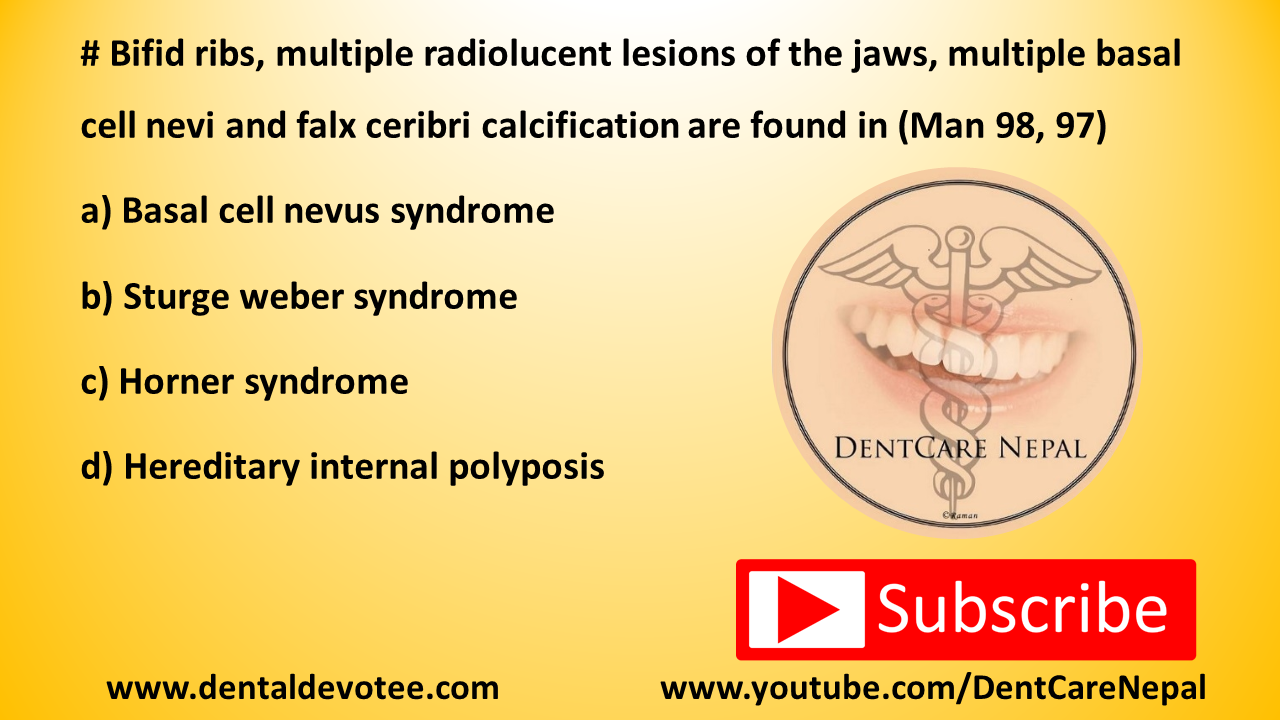
# Bifid ribs, multiple radiolucent lesions of the jaws, multiple basal cell nevi and falx ceribri calcification are found in (Man 98, 97) a) Basal cell nevus syndrome b) Sturge weber syndrome c) Horner syndrome d) Hereditary internal polyposis The correct answer is A. Basal cell nevus syndrome. Basal cell nevus syndrome is also called as Gorlin Goltz syndrome. Horner's syndrome is characterized by miosis, ptosis and anhidrosis over face due to interruption of sudomotor and vasomotor control. Hereditary intestinal polyposis is seen in Peutz-Jeghers syndrome.

Most aggresive odontogenic tumor

# Which of the following tumors is most aggressive? (AIPG 91, AIIMS2004) a) Ameloblastoma b) Odontoma c) Odontogenic myxoma d) Fibrocarcinoma The answer is C. Odontogenic myxoma ODONTOGENIC MYXOMAS Aggressive, intraosseous neoplasms derived from embryonic odontogenic mesenchyme probably arise from the dental papilla or follicular mesenchyme. Nearly all lesions are found in the tooth bearing areas of maxillary and mandibular bone. Mandibular lesions are commonly found in the premolar-molar area. The lesions often produce multilocular radiolucency with a "soap bubble' or "honey comb" appearance in the bone. Thin and extremely delicate septa of bone are often seen to course through the radiolucent area and produce a "spider- web" like or "tennis racket" like appearance.  (Ref: Shafer's Textbook of oral pathology 7h ed., p 299)

Type II Diabetes Causes

# Obesity, genetic profile, and aging all contribute to the development of Type II diabetes. Of the following, which is the most important additive factor for these three conditions in the development of Type II diabetes? A. elevated hepatic ketogenesis B. elevated pancreatic glucagon secretion C. impaired renal clearance of glucose D. muscle resistance to insulin Answer: D - Muscle resistance to insulin is the most important additive factor for these three conditions in the development of Type II diabetes. The progressive loss of skeletal muscle sensitivity to insulin leads to increased rates of visceral cell lipolysis and pancreatic beta-cell compensation.

Parasympathetic Cranial nerves

# # All of cranial nerve have parasympathetic outflow except : A. 5th nerve B. 7th nerve C. 3rd neve D. 9th nerve The correct answer is A. 5th nerve Cranial nerves having parasympathetic now are 3,7,9 and 10. Preganglionic parasympathetic neuron cell bodies are located in certain cranial nerve nuclei of the brain stem and in the grey matter of the second to fourth sacral segments of the spinal cord. Efferent fibres, which are myelinated, emerge from the CNS only in cranial nerves III, VII, IX, and X and in the second to fourth sacral spinal nerves. Preganglionic parasympathetic neurons are cholinergic.  The only cranial nerve which arises on the dorsal aspect   -       Trochlear The cranial nerve with longest intracranial coarse              -        Abducent The cranial nerve with longest coarse                      ...

Referred pain in Orofacial region:

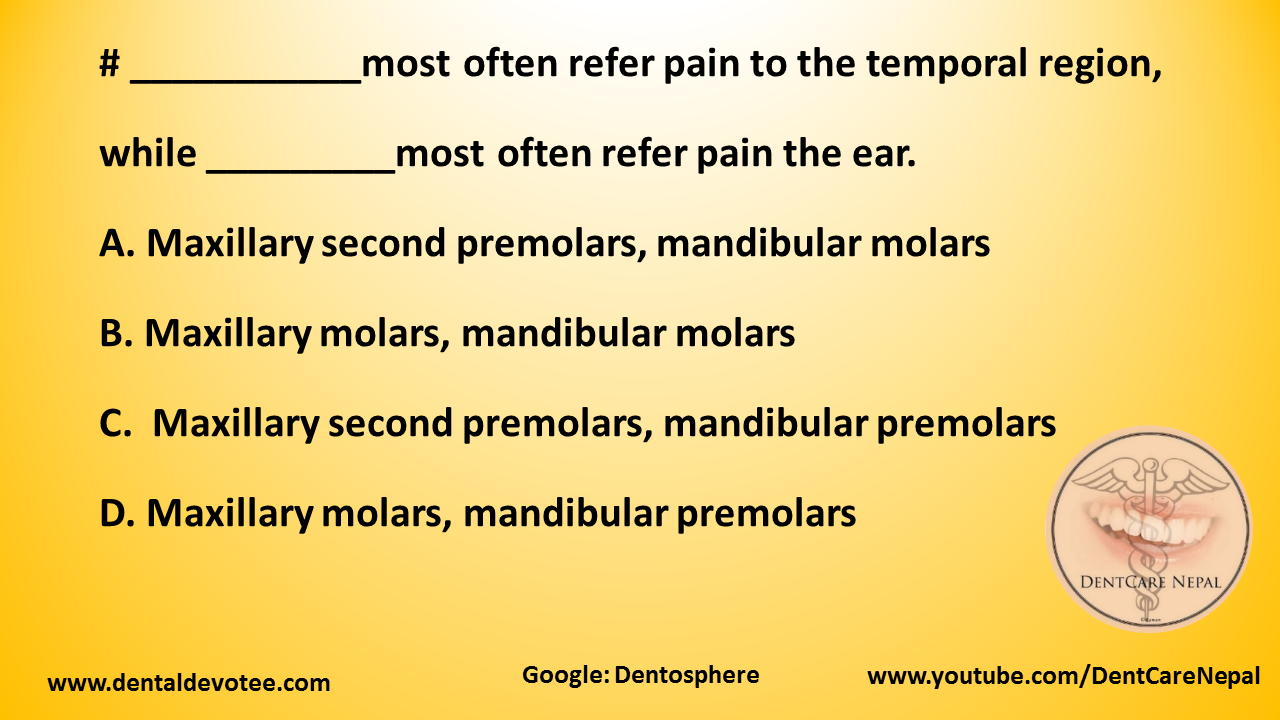
# ___________most often refer pain to the temporal region, while _________most often refer pain the ear. A. Maxillary second premolars, mandibular molars B. Maxillary molars, mandibular molars C.  Maxillary second premolars, mandibular premolars D. Maxillary molars, mandibular premolars The correct answer is A. Maxillary second premolars, mandibular molars. If careful diagnosis does not reveal the affected tooth, other teeth and related anatomic structures become suspect. Pulpitis in one tooth may cause pain in other areas - the pain is referred. Site of Pain Referral                              Pulp of Tooth Causing Pain Forehead region                                    Maxillary incisors Nasolabial area                      ...

Hydrolysis of Lactose, Maltose and Sucrose

# Which of the following statements is TRUE? (MAN-95) a) The hydrolysis of lactose yields glucose and galactose b) The hydrolysis of maltose yields glucose and fructose c) The hydrolysis of sucrose yields only glucose d) All of the above statements are true The correct answer is A. The hydrolysis of lactose yields glucose and galactose Carbohydrate Products Maltose 2 glucose units Sucrose 1 glucose + 1 fructose Lactose Galactose + glucose Starch Water soluble amylose and a water soluble amylopectin Inulin Polymer of fructose