Glass ionomer cement was introduced by Wilson and Kent in:

 # Glass ionomer cement was introduced by Wilson and Kent in:
a.1969
b.1972
c.1896
d.1989


The correct answer is B. 1972.

Glass ionomer cements are adhesive tooth colored anticariogenic restorative materials which were originally used for restorations of eroded areas. Current glass ionomers have been modified to allow a wider application. These cements evolved from a general dissatisfaction with silicate cements. The first usable glass ionomer system was formulated in 1972 by Wilson and Kent and was known as ASPA (alumino silicate polyacrylic acid). Subsequently great improvements were made and today these materials are very popular and widely used.

Crepitus will be seen in the tissues surrounding an infection by:

 # Crepitus will be seen in the tissues surrounding an infection by:
A. Staphylococcus
B. Streptococcus
C. Clostridium tetani
D. Clostridium perfringes


The correct answer is D. Clostridium perfringes. 

■ Clostridium perfringens causes gas gangrene or myonecrosis. 
■ Gas gangrene is characterized by skin colour change from pallor to bronze/purple discoloration and the skin is tense and exquisitely tender. 
■ Gas in the tissues may be obvious with crepitus on clinical examination or visible on radiograph. 
■ Surgical debridement, antibiotic therapy with high-dose I.V penicillin, clindamycin and metronidazole and hyperbaric oxygen therapy are used for treating gas gangrene [Note: Hyperbaric oxygen therapy is also used for osteoradionecrosis and chronic osteomyelitis]. 
■ Cl. tetani causes tetanus and cl. difficile causes pseudomembranous colitis. 


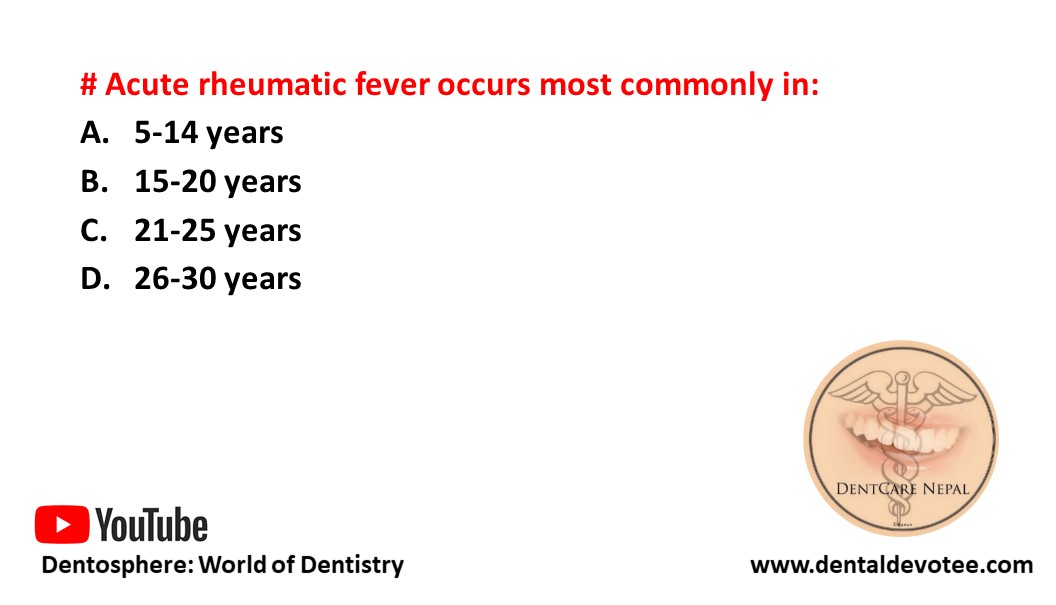
Acute rheumatic fever occurs most commonly in:

 # Acute rheumatic fever occurs most commonly in:
A. 5-14 years
B. 15-20 years
C. 21-25 years
D. 26-30 years


The correct answer is A. 5-14 years.

The incidence of acute rheumatic fever is highest in school aged children. The highest incidences recorded are in those aged 5-14 years. One study reported a median age of diagnosis of acute rheumatic fever of 10.4 years with an interquartile range between 8.7-14.3 years. 

The active ingredient of anticalculus dentifrices is:

 # The active ingredient of anticalculus dentifrices is:
A. Fluoride
B. Potassium nitrate
C. Ammonia
D. Pyrophosphate


The correct answer is D. Pyrophosphate.

Pyrophosphate has received particular attention in view of its proposed rote in inhibition of crystal growth. Nevertheless, it is unlikely that pyrophosphate in toothpastes will persist for a reasonable length of time in the mouth, because of the presence of considerable amounts of pyrophosphatase enzymes in saliva and oral bacteria. Pyrophosphate, when introduced into a simulated oral environment, is hydrolyzed by various phosphatases with concomitant loss of its inhibitory activity for calcification in vitro. To overcome this problem, a copolymer of vinyl methyl ether maleic anhydride (Gantrez) and NaF has been introduced in order to inhibit the hydrolysis of pyrophosphate. Animal and clinical studies have shown that toothpaste containing a combination of pyrophosphate, NaF and Gantrez, was highly effective in retarding supragingival calculus formation. 

Featured Post

Dental MCQs - Multiple Choice Questions in Dentistry

SELECT THE TOPIC YOU WANT TO PRACTICE. # LOK SEWA  AAYOG PAST QUESTIONS Medical Entrance Preparation MCQs # Digestive System and Nutriti...

Popular Posts