Paget’s test is done in the examination of

 # Paget’s test is done in the examination of:
A. A small swelling
B. Serum calcium
C. Urine analysis for alkaline phosphatase
D. Cytologic smear


The correct answer is A. A small swelling.

Paget's test is done for small swellings to know the consistency (cystic/solid). The centre and peripheries are palpated with index finger. Cystic swelling feels softer at centre than periphery whereas solid swelling feels firmer at center than periphery.

Which of the following is a general property of biofilms?

 # Which of the following is a general property of biofilms? 
a. Susceptible to host defenses. 
b. Limited habitat range. 
c. Open architecture.
d. Reduced virulence


The correct answer is C. Open architecture.

The close relationships between the architecture of a biofilm and its functional properties emphasizes the need to better describe and understand cell behavior, from single cell to multicellular scale, during biofilm structure development and maturation. Recent technological advances in methodologies including imaging and microscopy, molecular techniques, and physico-chemical assays, enabled the development of novel approaches dedicated to biofilm studies (Azeredo et al., 2017). The possibility to observe biofilm using high resolution and non-destructive methods now allows investigating the dynamics of multicellular structure development and the fate of each of its individual cellular components in parallel. For instance, the key architectural transitions and associated biophysical and genetic mechanisms supporting the developmental program of Vibrio cholerae biofilms have been recently disclosed using single-cell live imaging (Drescher et al., 2016; Yan et al., 2016). This kind of observations has clearly improved our understanding of spatio-temporal development of biofilms and has finally increasingly supported the intimate connection between structural modulations and the emergence of functional features and survival strategies. Indeed, the ability of biofilms to adapt their structure in response to internal or external stimuli, called hereafter the architectural plasticity, appears as a key factor affecting the fitness of individuals within the whole microbial community. Interestingly, the role of plasticity in bacterial survival was already demonstrated at the cellular scale. Bacteria are able to alter their morphology and to produce specific morphotypes conferring survival advantages in hostile environments. This was showed for numbers of bacterial pathogens for which filamentation is essential in the resistance to phagocytosis and overall for persistence during infection. 


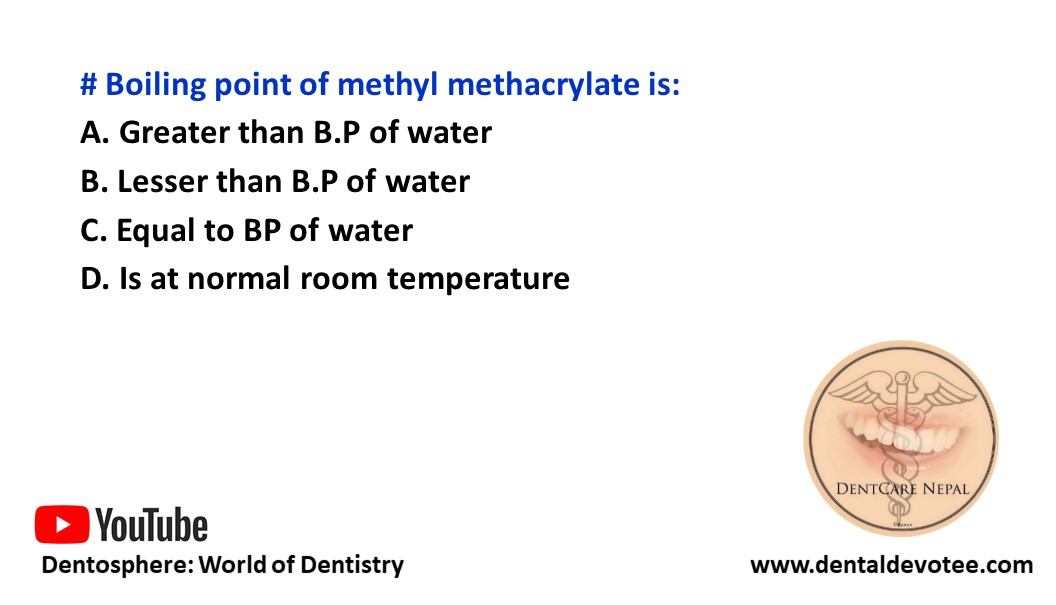
Boiling point of methyl methacrylate is:

# Boiling point of methyl methacrylate is:
A. Greater than B.P of water 
B. Lesser than B.P of water 
C. Equal to BP of water 
D. Is at normal room temperature 


The correct answer is A. Greater than Boiling Point of Water. 

Methyl methacrylate (MMA) is an organic compound with the formula CH2=C(CH3)COOCH3. This colorless liquid, the methyl ester of methacrylic acid (MAA), is a monomer produced on a large scale for the production of poly(methyl methacrylate) (PMMA).
Melting point : −48 °C (−54 °F; 225 K)
Boiling point : 101 °C (214 °F; 374 K)

Flow of Oxygen in Oxygen flush system

 # The oxygen flush system provides a higher flow of oxygen of ________ L/min when the patient’s need for oxygen is greater than the amount the breathing circuit can provide. 
a) 25-50 
b) 35-75 
c) 55-95 
d) 65-105 


The correct answer is B. 35-75.

Many anesthesia providers use the oxygen flush valve daily especially in those cases where the face mask fit is not optimal during the induction. When an emergency occurs it is comforting to know where a supply of oxygen is readily located, how much can be delivered, and that a flow is available despite the anesthesia being lifted on or off.

The oxygen flush can be used even when the anesthesia machine is not turned on and will operate in its regular fashion. It delivers oxygen straight from the pipeline or cylinder regulator at 45-50 psig (Pounds per square in gauge). The flow rate will be between 35-75 L/min. 

Featured Post

Dental MCQs - Multiple Choice Questions in Dentistry

SELECT THE TOPIC YOU WANT TO PRACTICE. # LOK SEWA  AAYOG PAST QUESTIONS Medical Entrance Preparation MCQs # Digestive System and Nutriti...

Popular Posts