Total Pageviews

Lok sewa Aayog Dental Surgeon Eighth Level Second Paper Question 2079/12/04

 Full Marks: 100                    Time : 3 hours

Subject - Dentistry 


SECTION A               20 Marks

1.  How does hemophilia impact dental treatment and what precautions should be taken by dental surgeon to ensure the safety of patients with hemophilia? Discuss.   4+6=10
2. Classify fibro-osseous lesions. Discuss in detail about Paget's disease of bone.    10

SECTION B      30 Marks

3. A patient comes with the swelling of the left side of face due to carious lower first molar; which space is involved by the infection? Write about the boundaries and treatment of the buccal space infection. Also state on Gow Gates technique.      2+5+3=10
4. Describe briefly various intraoral radiographic techniques. But among them, write in detail about bite wing radiography.      5+5=10
5. Explain in detail on nonvital bleaching with note on the various bleaching agents and its mechanism. 10 

SECTION C             30 Marks

6. Describe oral habits. Elucidate in detail about tongue thrusting habit. 5+5=10
7. What are the advantages and disadvantages of using glass ionomer as a restorative material in dentistry? And, in what situations is it most commonly used? Elaborate. 4+6=10
8. State pontic in fixed partial dentures. Discuss on the selection of pontics in clinical practice. 10


SECTION D      20 Marks
9. Mention different techniques to whiten discolored tooth. Discuss about walking bleach technique.  2+8=10
10. Suggest different possible public health strategies with justifications to improve oral health of population in rural areas of Nepal.    10

THE END 


A young patient has white thickening of buccal mucosa since birth and it also occurs in nose and esophagus. Most likely diagnosis is:

 # A young patient has white thickening of buccal mucosa since birth and it also occurs in nose and esophagus. Most likely diagnosis is: 
a. accumulation of fordyces granules 
b. chronic hyperplastic candidiasis 
c. white sponge nevus 
d. porokeratosis 


The correct answer is C. White sponge nevus. 

This mucosal abnormality is congenital in many instances. In other cases, it does not appear until
infancy, childhood, or even adolescence, by which time it has generally reached the full extent of its severity. The oral lesions may be widespread, often involving the cheeks, palate, gingiva, floor of the mouth, and portions of the tongue. The mucosa appears thickened and folded or corrugated with a soft or spongy texture and a peculiar white opalescent hue. There is sometimes a minimal amount of folding present. Ragged white areas may also be present which can be removed sometimes by gentle rubbing without any ensuing bleeding. 

Organ involvement of SLE is in:

 # Organ involvement of SLE is in:
a. kidney and Lungs 
b. kidney and heart 
c. lungs and heart 
d. heart and spleen 


The correct answer is B. Kidney and heart.

Systemic lupus erythematosus is a serious cutaneous-systemic disorder which characteristically manifests repeated remissions and exacerbations. This disease has its peak age of onset at about 30 years in females but about 40 years in males. The disease may occur in childhood as reported by Jacobs. Prevalence rates are higher in females than in males. A female-to-male ratio of approximately 2 : 1 occurs before puberty, and a ratio of 4 : 1 occurs after puberty.

The generalized manifestations of the systemic disease are referable to the involvement of various organs, including the kidney and heart. In the kidney, fibrinoid thickening of glomerular capillaries occurs, producing the characteristic ‘wire loops,’ which may be sufficient to result in renal insufficiency. The heart may suffer from an atypical endocarditis involving the valves, as well as fibrinoid degeneration of the epicardium and myocardium. The widespread tissue involvement and the nature of the lesions have led to the inclusion of this disease in that group known as the ‘collagen diseases,’ which also includes rheumatic fever, rheumatoid arthritis, polyarteritis nodosa, scleroderma and dermatomyositis.


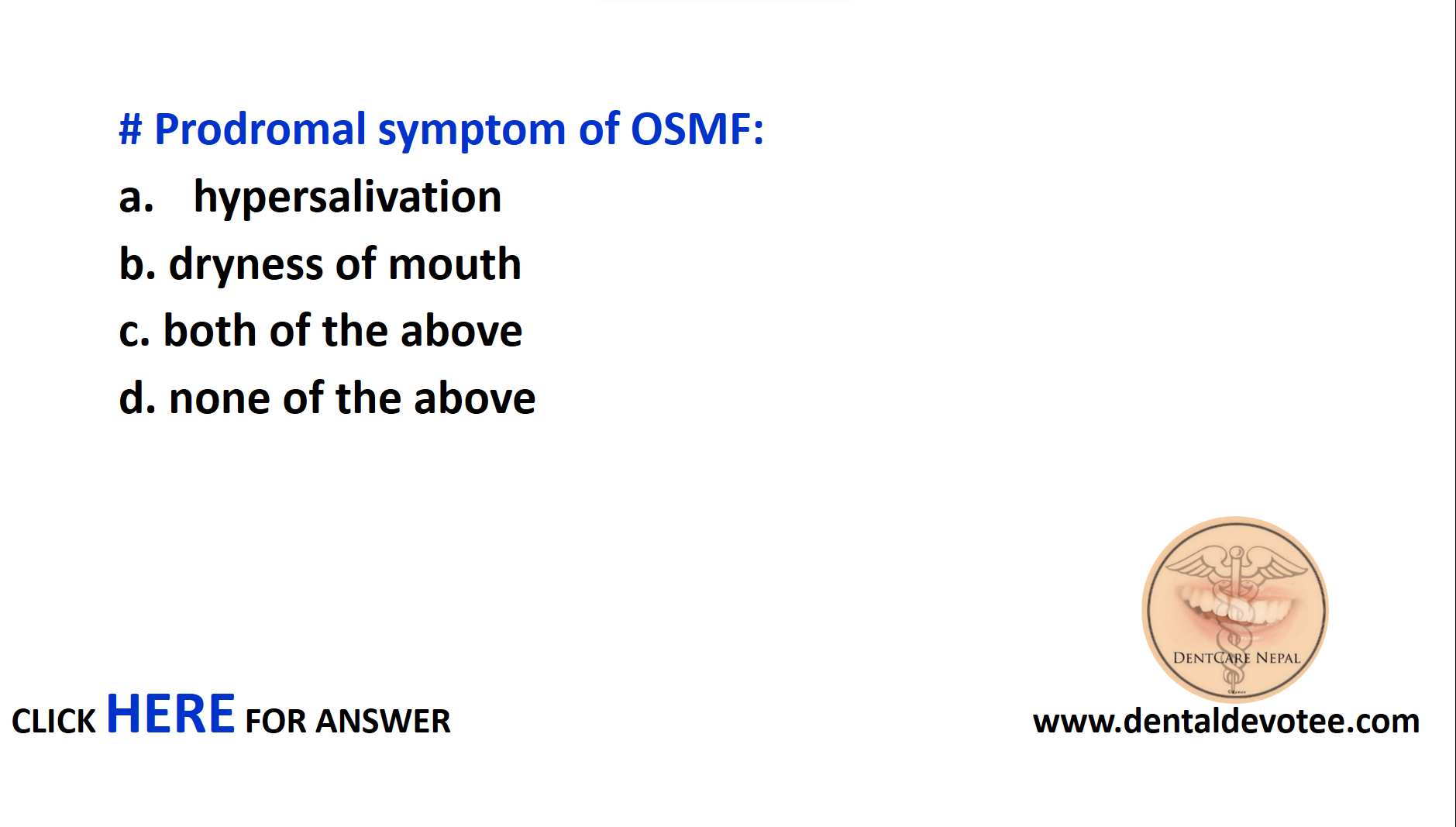
Prodromal symptom of OSMF:

 # Prodromal symptom of OSMF:
a. hypersalivation 
b. dryness of mouth 
c. both of the above 
d. none of the above 


The correct answer is C. Both of the above.

Prodromal Symptoms (Early OSF):
 This includes a burning sensation in the mouth when consuming spicy food, appearance of blisters especially on the palate, ulcerations or recurrent generalized inflammation of the oral mucosa,
excessive salivation, defective gustatory sensation and dryness of the mouth. There are periods of exacerbation manifested by the appearance of small vesicles in the cheek and palate. The intervals between such exacerbation vary from three months to one year. Focal vascular dilatations manifest
clinically as petechiae in the early stages of the disease. This may be part of a vascular response due to hypersensitivity of the oral mucosa towards some external irritant like arecanut products. Petechiae are observed in about 22% of OSF cases (Rajendran, 1994), mostly on the tongue followed by the labial and buccal mucosa with no sign of blood dyscrasias or systemic disorders. Pain in areas where submucosal fibrotic bands are developing when palpated is a useful clinical test. Histologically, they revealed a slightly hyperplastic epithelium, sometimes atrophic with numerous dilated and blood-filled capillaries juxtaepithelially. The inflammatory cells seen are mainly lymphocytes, plasma cells and occasional eosinophils. The presence together of large numbers of lymphocytes and fibroblasts as well as plasma cells in moderate numbers, suggests the importance of a sustained lymphocytic infiltration in the maintenance of the tissue reaction in OSF. 

Featured Post

Dental MCQs - Multiple Choice Questions in Dentistry

SELECT THE TOPIC YOU WANT TO PRACTICE. # LOK SEWA  AAYOG PAST QUESTIONS Medical Entrance Preparation MCQs # Digestive System and Nutriti...

Popular Posts