Gingival enlargement can be expected in all of the following patients EXCEPT:

 # Gingival enlargement can be expected in all of the following patients EXCEPT:
A. A patient who has undergone kidney transplant
B. A patient with COPD
C. An epileptic patient
D. Patient on antihypertensive therapy


The correct answer is B. A patient with COPD.

Gingival enlargement is a well-known consequence of the administration of some anticonvulsants (epileptic patient), immunosuppressants (organ transplant recipient), and calcium channel blockers (antihypertensive). The condition may create speech, mastication, tooth eruption, and aesthetic problems.  

Which of the following cytokeratin is not found in orthokeratinized epithelium?

 # Which of the following cytokeratin is not found in orthokeratinized epithelium?
A. K9
B. K10
C. K11
D. K19


The correct answer is D. K19

Keratins K1, K2, and K10 through K12, which are specific to epidermal-type differentiation, are immunohistochemically expressed with high intensity in orthokeratinized areas and with less intensity in parakeratinized areas. K6 and K16, which are characteristic of highly proliferative epithelia, and K5 and K14, which are stratification-specific cytokeratins, also are present. Parakeratinized areas express K19, which is usually absent from orthokeratinized normal epithelia.


PDL fibers that prevent extrusion are:

 # PDL fibers that prevent extrusion are: 
A. Horizontal
B. Oblique
C. Transseptal
D. Alveolar crest fibers


The correct answer is D. Alveolar crest fibers.

Alveolar crest fibers extend obliquely from the cementum just beneath the junctional epithelium to the alveolar crest. Fibers also run from the cementum over the alveolar crest and to the fibrous layer of the periosteum that covers the alveolar bone. The alveolar crest fibers prevent the extrusion of the tooth and resist lateral tooth movements. The incision of these fibers during periodontal surgery does not increase tooth mobility unless significant attachment loss has occurred.

Reference: Carranza's


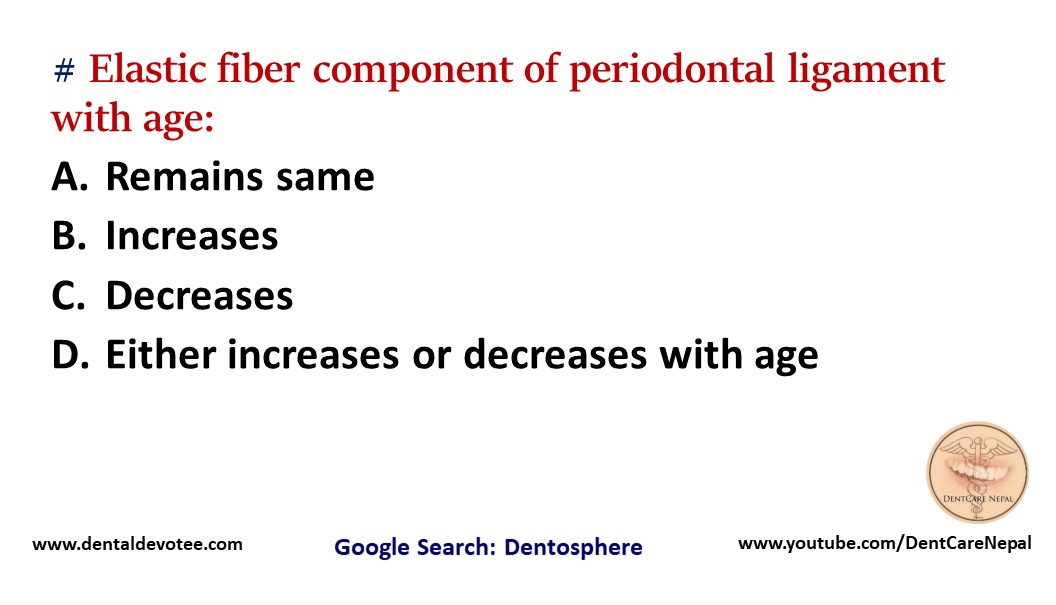
Elastic fiber component of periodontal ligament with age:

 # Elastic fiber component of periodontal ligament with age:
A. Remains same
B. Increases
C. Decreases
D. Either increases or decreases with age


The correct answer is B. Increases. 

Changes in the periodontal ligament that have been reported with aging include decreased numbers of fibroblasts and a more irregular structure, thus paralleling the changes seen in the gingival connective tissues. Other findings include decreased organic matrix production, epithelial cell rests, and increased amounts of elastic fiber.

Featured Post

Dental MCQs - Multiple Choice Questions in Dentistry

SELECT THE TOPIC YOU WANT TO PRACTICE. # LOK SEWA  AAYOG PAST QUESTIONS Medical Entrance Preparation MCQs # Digestive System and Nutriti...

Popular Posts